What Is a Jurat in Arizona?
A jurat is a notary act where you sign a paper in front of a notary and swear or promise that what it says is true. It is used for affidavits, sworn statements and other papers that must be truthful. You must sign while the notary watches, so don’t sign ahead of time. You also need a current photo ID. A mobile notary can come to your home, office or hospital room to do it.
How Does a Jurat Work?
A jurat only takes a few minutes. It has a few simple steps, and the notary walks you through each one.
- The notary checks your photo ID.
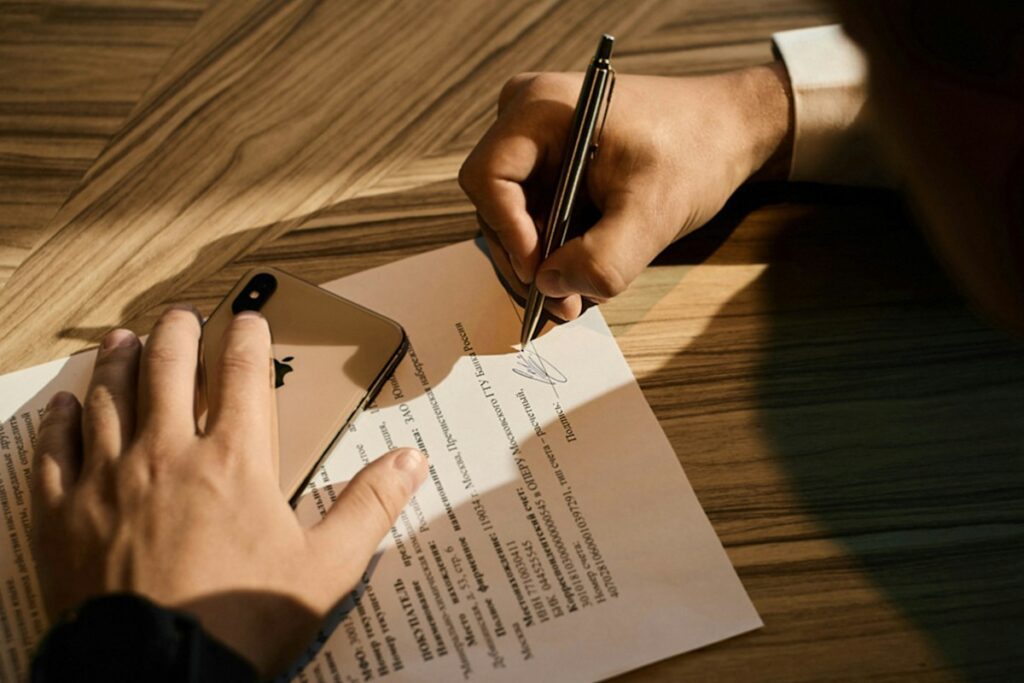
- You sign the paper while the notary watches.
- The notary asks you to swear or affirm that the paper is true.
- You answer out loud, usually with “I do.”
- The notary fills out the jurat certificate and adds a seal.
- You sign the notary journal.
That’s it. You leave with your paper, ready to send to the court, lawyer or office that asked for it.
What Does a Jurat Certificate Say?
The jurat is the notary wording at the end of your paper. It usually says “subscribed and sworn to before me” or “subscribed and affirmed before me.” Subscribed just means signed.
The certificate also lists the date, the place, your name and the notary’s name. The notary signs it and adds an official seal.
If your paper has no notary wording at all, don’t worry. The notary can attach a separate certificate. But the notary can’t choose which kind for you. More on that below.
Jurat vs. Acknowledgment: What’s the Difference?
People mix these two up all the time. Both are common in Arizona, but they do different jobs.
- Jurat: You sign in front of the notary and swear the paper is true.
- Acknowledgment: You confirm the signature is yours and that you signed by choice. You may sign before the visit.
A deed or power of attorney usually needs an acknowledgment. An affidavit or sworn statement usually needs a jurat. Read more in What Is a Notary Acknowledgment in Arizona?
What Papers Need a Jurat?
Any paper where you swear the facts are true will likely need a jurat. Here are common ones we see in Scottsdale and Phoenix:
- Affidavits, like an affidavit of residency or identity
- Small estate affidavits for bank accounts and vehicles
- Sworn statements for court cases
- Verified insurance claim forms
- Gift letters for home loans
- Statements for schools, employers or the MVD
If your paper says “sworn,” “verified” or “under oath,” it probably needs a jurat.
Oath or Affirmation: Which Should I Choose?
You get to choose. An oath is a promise that often mentions God. An affirmation is the same promise made on your own honor, with no religious words.
Both carry the same weight under Arizona law. The notary will ask which one you want, and there is no wrong answer.
Either way, the promise is serious. Lying on a sworn paper can be a crime called perjury under A.R.S. 13-2702.
What ID Do I Need for a Jurat?
You need a current ID with your photo and signature. A driver license, state ID card, passport or military ID all work well.
The name on your ID should match the name on your paper. If it doesn’t, text us before the visit so we can help you plan.
You can read about Arizona notary rules on the Arizona Secretary of State website. Arizona’s notary terms, including the word jurat, are in A.R.S. 41-311.
How Do I Get Ready for a Jurat?
A little prep makes your visit smooth. Before the notary arrives, go through this short list:
- Read your paper all the way through.
- Make sure every fact is true and correct.
- Fill in every blank, or write N/A where it doesn’t apply.
- Leave the signature line empty until the notary is there.
- Have your photo ID ready.
If a court or lawyer gave you the paper, check for any special steps. Some want the notary’s county listed or a certain date format. It never hurts to ask them ahead of time.
What Happens After the Jurat Is Done?
You get your paper back right away. The notary does not keep it. We only keep the journal entry, which shows the date, the type of paper and how we checked your ID.
Next, send the paper where it needs to go. That might be a court clerk, an insurance company, a lender, a school or a lawyer. Ask them if they want the original or if a copy is okay.
It’s smart to make a copy for yourself before you hand it over. That way you have proof of what you signed and when.
Does a Jurat Need a Thumbprint?
Most jurats do not. Arizona’s new thumbprint rule, which started September 12, 2026, covers powers of attorney, deeds and other papers that affect real property.
But some sworn papers deal with a home or land. In that case, the notary may need your right thumbprint in the journal. It only takes a moment. Read more about the Arizona notary thumbprint requirement.
Can the Notary Write My Affidavit?
No. Arizona notaries can’t give legal advice. That means we can’t write your affidavit, tell you what to say or explain how a court will use it.
If you need help with the words, talk to a lawyer or the office that asked for the paper. Many courts also have self-help centers with free forms.
Once your paper is written, we can notarize it. For more tips, read how to get a document notarized in Arizona.
Can a Notary Come to Me for a Jurat?
Yes. A mobile notary comes to you. That is a big help when you are short on time, don’t have a ride or are caring for someone at home.
We also visit hospitals and care homes. The signer must be alert, able to sign and able to understand the oath. Learn more in Can a Notary Come to Your Home or Hospital?.
Our mobile notary services in Scottsdale cover many other papers too.
Get Your Jurat Notarized in Scottsdale
Arizona Notary Etc. comes to you in Scottsdale, Paradise Valley, Fountain Hills, Tempe, Phoenix and nearby towns. We meet you at home, at work, at a hospital or at a care home.
See our Jurats & Sworn Statements service to learn more about what we notarize and how visits work.
Text or call 480.628.7838. A real person answers, not a robot.
Frequently Asked Questions About Jurats in Arizona
Can I sign before I meet the notary for a jurat?
No. For a jurat, you must sign in front of the notary. If you signed early, you may need a new copy to sign during the visit.
Does the notary check if my statement is true?
No. The notary checks who you are and gives you the oath. You are the one promising that the statement is true.
Is a sworn statement the same as an affidavit?
They are very close. An affidavit is a written sworn statement. Both are usually notarized with a jurat.
Can my spouse swear to the paper for me?
No. Each person who signs must take their own oath in front of the notary.
How long does a jurat take?
Most jurats take about five to ten minutes once everyone is ready with their ID and papers.